Betrayal in Indianapolis? Why Fans Believe the Indiana Fever are Actively Sabotaging Caitlin Clark’s Career

In the high-stakes world of professional sports, the playbook for handling a “generational talent” is usually written in stone: you find the superstar, you clear the path, and you build every single brick of the organization around their unique strengths. From the Chicago Bulls with Michael Jordan to the Las Vegas Aces with A’ja Wilson, the logic is undeniable. However, as the 2026 WNBA season looms, the Indiana Fever appear to be throwing that playbook into the shredder.
A series of baffling off-season moves, coupled with startling public admissions from Team President Kelly Krauskopf and Head Coach Stephanie White, has ignited a firestorm of controversy. The central question dominating social media and sports talk radio is as simple as it is disturbing: Is the Indiana Fever front office intentionally sabotaging Caitlin Clark?
The Draft Night Disaster: A Psychological Gaffe?
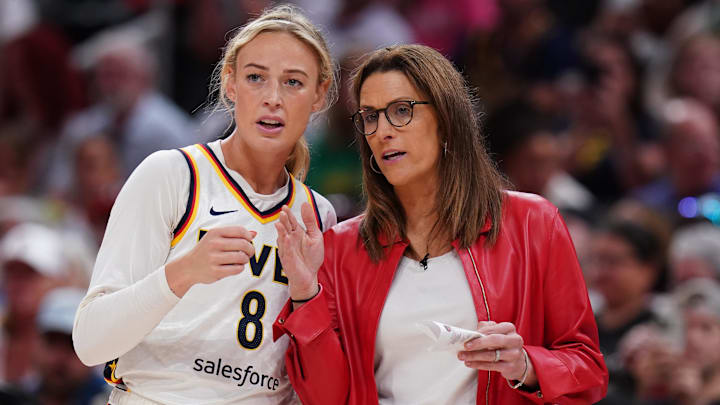
The first tremor of the off-season occurred during the 2026 WNBA draft. Just weeks prior, former South Carolina guard Raven Johnson sat for a media interview where she revealed that Caitlin Clark had “broken her” emotionally during their collegiate matchups. Johnson spoke candidly about the toll Clark’s competitiveness took on her, even mentioning how it led her to a “bubble of isolation.”
While Johnson is a formidable defensive player, the optics of the Fever using their 10th overall pick to select her were catastrophic. Instead of addressing the team’s desperate need for frontcourt depth or floor spacing, the Fever chose a sixth guard—one with a public history of emotional friction with their franchise centerpiece. General Manager Amber Cox called the pick a “home run,” but for Clark’s massive fan base, it felt like a deliberate attempt to introduce tension into the locker room before training camp even began.
Strategic Incompetence or Calculated Limitation?
Beyond the psychological implications, the basketball math simply doesn’t add up. Entering the draft, the Fever already boasted a crowded backcourt with Clark, Kelsey Mitchell, Tayasha Harris, Sophie Cunningham, and Lexi Hull. By adding Johnson, a 5’9″ guard with an unproven offensive game at the professional level, the front office ignored glaring holes in their roster.
Analysts have been shouting from the rooftops for two seasons that Indiana needs a “stretch four”—a versatile forward who can shoot from the perimeter to take pressure off Aliyah Boston and open driving lanes for Clark. Instead, the Fever passed on established free agents like Azurá Stevens and Rebecca Allen, opting to enter the season with a roster that features eight guards and only one true, veteran center.
This structural imbalance forces Aliyah Boston to carry the entire frontcourt burden alone. When the Fever face elite teams like the New York Liberty or Las Vegas Aces, they will be severely undersized. Opposing defenses will likely pack the paint, daring Indiana to beat them from the perimeter, effectively neutralizing the pick-and-roll game that made Clark the league’s assist leader.
The Coach’s Admission: Moving Clark Off the Ball
If the roster construction raised eyebrows, Head Coach Stephanie White’s recent comments turned those eyebrows into full-blown alarms. In a post-draft interview, White admitted that the acquisition of more guards was a calculated move to change Clark’s role. “Caitlin is a player who can play on and off the ball,” White stated, explaining that she wants the ball in the hands of other playmakers more often.
This philosophy is, quite frankly, baffling to basketball purists. Caitlin Clark’s “gravity”—her ability to pull defenders 30 feet away from the hoop just by holding the ball—is what makes the Indiana offense function. When Clark initiates the play, defenses scramble, creating open looks for Mitchell and easy post-entries for Boston. By moving her to the corner as a “catch-and-shoot” threat, the Fever are voluntarily relinquishing their greatest competitive advantage.
A Culture of “Adjustment”
The final piece of the puzzle came from Team President Kelly Krauskopf, who suggested that Clark needs to “adjust” to the roster and the system, rather than the organization catering to her. In a league that has been revitalized by the “Caitlin Clark Effect,” hearing the team president treat the most impactful rookie in history as a “variable” that needs to fit into a pre-existing (and arguably failing) system is unprecedented.
Krauskopf’s framing suggests that the Fever organization views the roster as a fixed entity and Clark as someone who must shrink her game to accommodate it. This “system-first” approach is often the hallmark of struggling franchises that fail to capitalize on once-in-a-lifetime talent.
Winning in Spite of the Front Office
As the 2026 season approaches, the Indiana Fever find themselves in a bizarre position. They have the most popular player in the world, a dominant young post in Aliyah Boston, and a fan base that is more engaged than ever before. Yet, the leadership seems intent on making the path to a championship as difficult as possible.
While the talent of Clark and Boston may be enough to drag this team to the playoffs, surviving bad management is a far cry from building a dynasty. For now, the fans are watching closely, and the pressure is no longer just on the players to perform—it’s on the front office to prove that they aren’t the biggest obstacle in Caitlin Clark’s way.